Follow Me On Social Media!


Why Your Domain Extension Matters More Than You Think
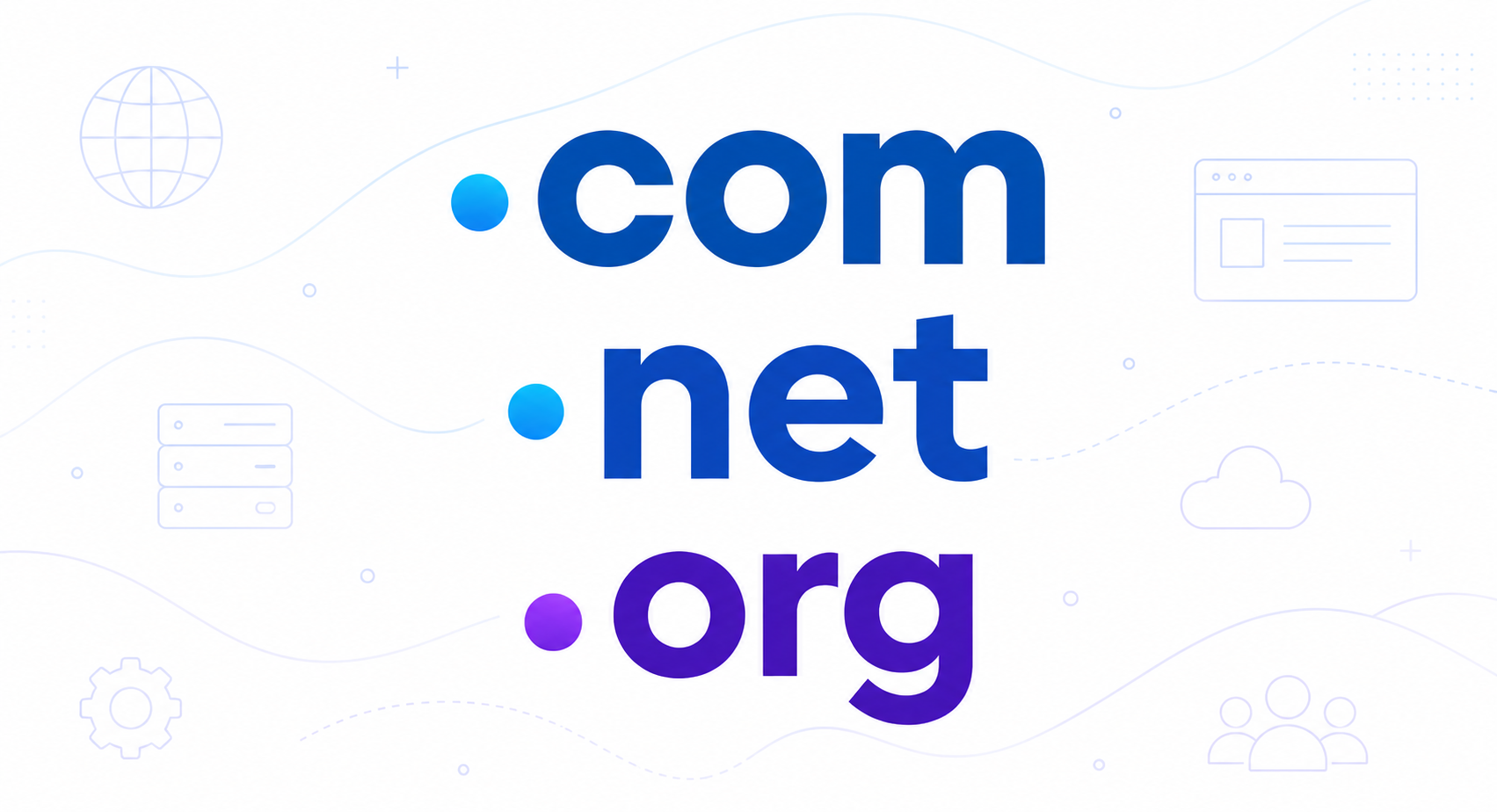
Let’s be real — when you’re building a brand online, most people obsess over the name and completely forget about what comes after the dot. But that little suffix? It’s doing a lot of heavy lifting.
Your domain extension (technically called a Top-Level Domain, or TLD) is one of the first signals you send to visitors before they even click your link. It whispers things like “we’re a legit business” or “we’re a non-profit you can trust” — or, unfortunately, “we couldn’t get the good one.”
Here’s how the whole thing works under the hood: when someone types your URL into a browser, the Domain Name System (DNS) acts like a giant phone book, routing that request to the right IP address where your website lives. Simple enough. But the TLD you choose shapes how users perceive you before any of that even happens.
Key Takeaway: While .com is the commercial gold standard, the best domain extension for your brand depends on what your organization actually is — its legal status, its audience, and its long-term goals. There’s no one-size-fits-all answer here.
Table of Contents
.COM: Still the King, But the Castle Is Getting Crowded
Let’s start with the big one. As of 2022, over 50% of all websites on the internet use .com. That’s not a coincidence — it’s a decade-plus of muscle memory baked into how people use the internet.
When someone hears a brand name, their brain automatically appends “.com” before they’ve even typed a character. It’s basically the default setting for human brains at this point.
Why .COM Still Wins
- Brand recall is unmatched. It’s the first thing people type when guessing a URL.
- Trust is built in. The “.com” connotation has meant “commercial business” since the internet’s earliest days, and users associate it with legitimacy.
- SEO-wise, it’s a neutral playing field — but the familiarity factor absolutely helps with click-through rates.
The Big Catch
Here’s the not-so-fun part: if you want a short, memorable .com name, you’re probably a decade too late. Most of the good ones are gone — either actively used, sitting with domain squatters, or listed on aftermarket sites for eye-watering prices.
Best For
For-profit businesses, startups, e-commerce stores, personal brands — basically anyone building something meant to generate revenue.
.NET: The Underdog That’s Actually Pretty Solid
.NET was originally designed for — you guessed it — network infrastructure companies. Think internet service providers, telecom businesses, and tech firms building the plumbing of the web.
These days, those original rules are more of a suggestion than a hard requirement (more on that in a bit), and .net has quietly become a pretty viable alternative for businesses that couldn’t snag their preferred .com.
Why .NET Deserves More Credit
- Availability is way better. If “your-brand-name.com” is taken, there’s a solid chance “your-brand-name.net” is wide open.
- It still reads as professional — it’s not some obscure extension nobody’s heard of.
- Great fit for tech-adjacent brands where the network connotation actually adds meaning.
The Honest Downside
The big hurdle is user default behavior. If someone hears about your brand and types the URL from memory, they’re probably going to add “.com” instinctively. That means you might be handing traffic to whoever owns your .com equivalent — which is awkward, to say the least.
Best For
Tech companies, SaaS products, digital agencies, and businesses where the .com version is legitimately unavailable but whose branding is strong enough to make the .net stick.
.ORG: The Trust Badge of the Internet
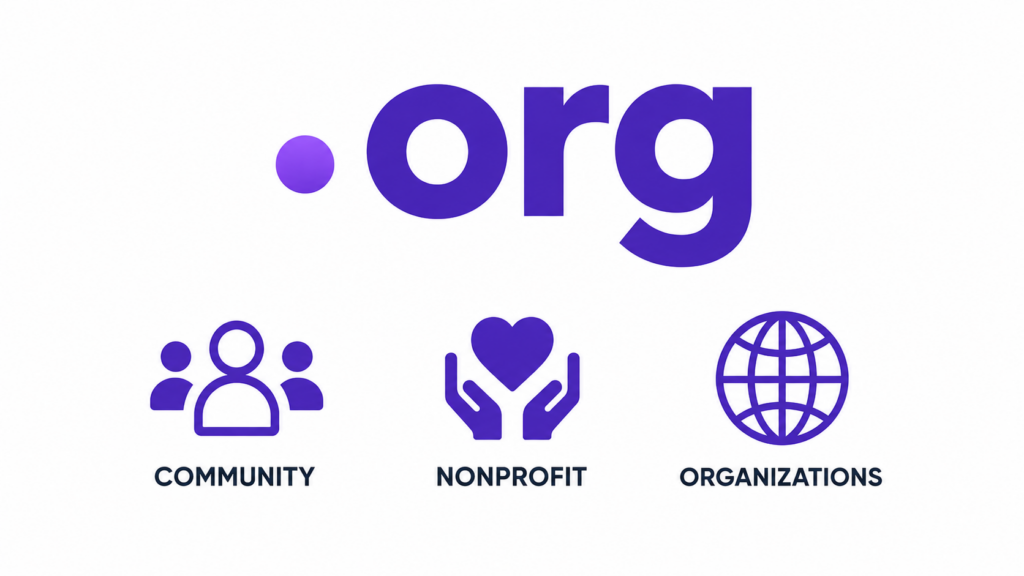
If .com is the business suit, .org is the nonprofit vest with a volunteer button on it. And that’s not a bad thing at all — it’s actually a superpower if you use it correctly.
The .org extension carries a deep cultural association with non-profit organizations, charities, NGOs, open-source communities, and advocacy groups. When users see a .org URL, they’re already primed to think: these people aren’t in it for the money.
Why .ORG Is Perfect for the Right Organization
- Trust factor is enormous. For charities and non-profits, .org can be the difference between someone clicking that “Donate” button or bouncing because something felt off.
- Credibility in global sectors. Health organizations, educational communities, and open-source projects have long used .org to signal transparency and public service.
- Still widely recognized — it’s not a weird extension that makes people squint.
The Unbreakable Rule of .ORG
Here’s the rule of thumb you should absolutely tattoo on your brain: if your primary goal is making a profit, stay away from .org.
Using a .org when you’re running a for-profit business is misleading — intentionally or not. Users expect something different from a .org site, and when they figure out you’re selling them something, it feels like a bait-and-switch. That’s bad for trust, and trust is everything online.
Best For
Charities, NGOs, non-profit communities, open-source projects, religious organizations, and educational advocacy groups.
Open vs. Closed TLDs: The Part Most People Skip
Here’s something genuinely useful that most “domain guide” articles gloss over: not all TLDs are created equally accessible.
Open TLDs (Anyone Can Register)
.com, .net, and .org are all “open” TLDs. That means anyone — individual, business, non-profit, whoever — can register them without proving anything about who they are or what they do. There’s no gatekeeper checking whether your non-profit is actually a non-profit before handing you a .org.
This openness is why you can technically register a .org for your pizza shop (though, please don’t).
Closed or Restricted TLDs (Eligibility Required)
Some extensions have real gatekeepers. To register these, you have to prove you qualify:
- .gov — U.S. government entities only. Period.
- .edu — Accredited post-secondary educational institutions only.
- .museum — Requires verification from the museum community.
- .travel — Reserved for verified businesses in the travel and tourism industry.
Country Code TLDs (like .uk, .de, .ca) are another category worth knowing about. These often require proof that your organization is legally registered within that country, though some countries sell theirs more openly than others (looking at you, .io and .co).
The Smart Strategy: Register More Than One Extension
Okay, here’s where things get a little more strategic — and honestly, this tip alone might save you some real headaches down the road.
Maybe Can help you : How to Use WordPress in 2026 – A Beginner’s Guide (No Tech Degree Required!) – WaveWrite
Defensive Registration (Don’t Skip This)
Even if your primary site runs on .com, you should seriously consider registering your brand name across .net and .org too — and maybe even .co if it’s relevant. This is called defensive registration, and it’s basically brand insurance.
Why? Because if you don’t, someone else might. And now you’ve got a competitor (or a scammer) sitting on a URL that’s one letter different from yours.
Domain registration is cheap — usually $10–15 per year per extension. The cost of not doing it can be a lot more painful.
The Redirect Strategy
Once you’ve registered those extra domains, point them all back to your primary URL. This way, if someone accidentally types “.net” instead of “.com” (which happens more than you’d think), they land exactly where you want them — on your site, not a dead page or someone else’s.
Most domain registrars make this dead simple with a basic redirect setting. Takes about five minutes to set up and it’s absolutely worth it.
Comparison Table: .COM vs. .NET vs. .ORG at a Glance
| Feature | .COM | .NET | .ORG |
|---|---|---|---|
| Original purpose | Commercial businesses | Network infrastructure | Non-profit organizations |
| Open registration? | Yes | Yes | Yes |
| Availability | Low — most names taken | Moderate | Moderate |
| User trust level | Very high (default expectation) | Medium | High (for non-profits) |
| Brand recall | Excellent | Fair | Good within context |
| Best for | For-profit businesses | Tech companies, alternatives | Charities, NGOs, communities |
| Risk of misuse | Low | Low | Misleads users if used commercially |
Frequently Asked Questions
1. Does my domain extension affect my Google rankings?
Not directly. Google has repeatedly stated that TLDs like .com, .net, and .org are treated equally for SEO purposes. That said, user behavior indirectly affects rankings — if people trust your domain more and click more often (or stay longer), that sends positive signals to search engines.
For More Details :Does Your Domain Affect Google Rankings? Here’s the Truth-GNAME | News: Get Latest Insights Of Domain & Cloud Trends
2. Can I switch domain extensions later without losing SEO?
You can, but it’s not trivial. Changing your domain (including the TLD) requires a proper 301 redirect setup and will temporarily impact your search rankings. It’s a better idea to choose the right extension from the start.
3. Is it bad to use .net if .com is available?
Not necessarily, but it’s not ideal either. If the .com is available for a reasonable price, grab it. The .com should always be your first choice for a commercial brand. Only go .net if .com is genuinely out of reach.
4. Do I need to be an actual non-profit to register a .org?
Technically, no — .org is an open TLD, so anyone can register it. But ethically (and practically), you shouldn’t use .org for a for-profit venture. It misleads users and damages trust when they figure it out.
5. What’s the easiest way to check availability across multiple extensions at once?
Use a domain name generator or registrar search tool like Namecheap, GoDaddy, or Google Domains. Most of them show you availability across multiple TLDs simultaneously, so you can compare options in seconds instead of searching one by one.
6. Should I register international country-code TLDs for my brand?
If you’re actively operating in specific countries, yes — especially for markets where local TLDs (like .co.uk or .de) significantly build trust with local audiences. Otherwise, focus on the core extensions first.
Key Takeaways
- .com is the default for commercial brands — highest trust, highest recall, lowest availability.
- .net is a solid backup for tech-adjacent businesses when .com is unavailable.
- .org is a credibility booster for non-profits and communities — but a trust-breaker for for-profit brands.
- All three are open TLDs — no eligibility required, but that doesn’t mean anything goes.
- Defensively register multiple extensions and redirect them to your primary domain.
- Before you do anything, know your brand — your audience, your goals, and your legal status all inform the right choice.
Making the Final Call
Choosing a domain extension really comes down to one question: what does your organization actually do, and who are you trying to reach?
If you’re building a business to make money — .com, all day, every day. If you’re running a charity, a community org, or an open-source project — .org will serve you better than you might expect. And if you’re a tech company that missed out on the .com you wanted — .net is a perfectly respectable second home.
The most important thing? Don’t overthink it to the point of paralysis. Start with a domain name generator to see what’s available across all extensions simultaneously, pick the one that fits your brand’s identity, and get to building.
Your domain is your digital front door. Make sure it opens somewhere people actually want to walk into.
Read our latest guide for more
How I Host My WordPress Site for Free on Cloudflare Pages – WaveWrite
Link Your Domain with Cloudflare: Why Every Website Owner Should Do It – WaveWrite